

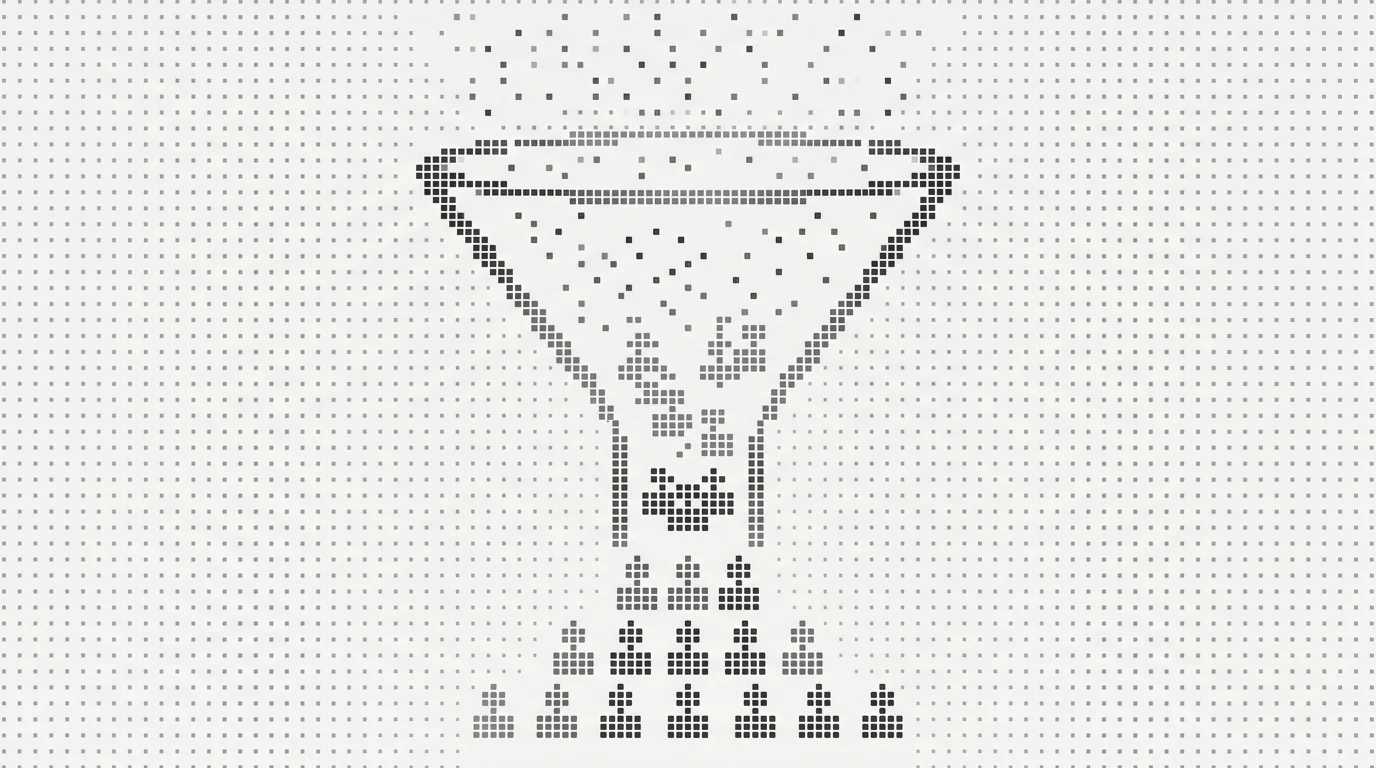
The lead form is the most sacred object in B2B marketing. Every landing page has one. Every campaign drives to one. Every marketer is measured by how many people fill one out.
And it’s failing.
The average B2B form conversion rate is 2.3% (consistent with data from Unbounce’s Conversion Benchmark Report and our own visitor-to-conversion gap study). That means for every 100 visitors you drive to a landing page — visitors you paid for with ads, content, and SEO — 97-98 leave without converting. They see the form, do the mental math (give up my email = get spammed by an SDR), and bounce.
This isn’t a new problem. What’s new is that the conversion rate is getting worse, not better. Despite billions spent on CRO tools, A/B testing, and “high-converting” landing page templates, form conversion rates have declined year over year since 2020.
The lead form isn’t going to disappear tomorrow. But its dominance as the primary mechanism for B2B lead capture is ending. Here’s why, and what’s replacing it.
The Numbers: Forms Are Converting Less Every Year
The trend is clear across every benchmark study and dataset I’ve seen:
B2B Form Conversion Rates Over Time
| Year | Average Form Conversion Rate | Change |
|---|---|---|
| 2018 | 4.2% | Baseline |
| 2020 | 3.6% | -14% |
| 2022 | 3.0% | -17% |
| 2024 | 2.6% | -13% |
| 2026 | 2.3% | -12% |
An aggregate decline of 45% over eight years. And this is the average — specific industries and page types are declining faster.
By Form Type
| Form Type | 2022 Conversion Rate | 2026 Conversion Rate | Change |
|---|---|---|---|
| Gated content (eBook, whitepaper) | 8-12% | 4-7% | -45% |
| Newsletter signup | 3-5% | 1.5-3% | -40% |
| Demo request | 2-4% | 1.5-3% | -30% |
| Contact form | 3-5% | 2-4% | -25% |
| Free trial signup | 5-8% | 3-6% | -30% |
Gated content has been hit hardest — down 45% in four years. Buyers have realized they can find equivalent information ungated elsewhere, and the cost of downloading (inbox pollution from nurture sequences) is no longer worth the content.
Why Forms Are Dying: 5 Structural Forces
1. Buyers Have Learned the Trade
Every B2B professional has filled out a form and immediately received a flood of SDR emails, nurture sequences, and calendar invites. They’ve been trained by experience: form = sales harassment.
This conditioning is so strong that many buyers now use fake information on forms. A study by Demand Gen Report found that 34% of B2B buyers admit to providing false contact information on gated content forms. They want the content but don’t want the follow-up.
When a third of your leads are providing bad data, the form isn’t just underperforming — it’s generating garbage.
2. The Research Phase Has Gone Underground
Gartner’s research shows that B2B buyers are 70%+ through their evaluation before engaging with a vendor. They’re consuming content, comparing solutions, and building shortlists — all anonymously.
This means the form captures the very end of the buying process. The prospect has already made most of their decisions by the time they’re willing to fill out a form. You’re entering the conversation late, after the opinions that matter have already formed.
3. Privacy Awareness Is Rising
People are increasingly protective of their personal information. With GDPR, CCPA, and constant data breach headlines, the average professional thinks twice before handing over their email to a B2B vendor. Cisco’s Data Privacy Benchmark Study found that 86% of consumers care about data privacy and want more control. They know what happens to that data — and they don’t like it.
This is especially true for younger decision-makers. Millennials and Gen Z buyers, who are now the majority of B2B purchasing committees, are more privacy-conscious and more resistant to traditional lead capture than their predecessors.
4. Alternatives to Gated Content Exist
There was a time when the only way to get a comprehensive industry report was to download it behind a form. That era is over. Today:
- Blog posts cover most topics in equal or greater depth than eBooks
- AI assistants can synthesize research on demand
- Community content (Slack groups, LinkedIn, Reddit) provides peer insights without forms
- Ungated competitors make your gated content look behind-the-times
When you gate content, you’re not creating scarcity — you’re creating friction. And in 2026, friction loses.
5. The Real Cost of Forms Is Hidden
Most marketing teams measure form conversion rates. Few measure the full cost of the form-dependent model:
| Hidden Cost | Impact |
|---|---|
| Lost visitors | 97-98% of traffic never captured |
| Bad data | 34% of form fills contain false information |
| SDR waste | Hours spent qualifying and chasing bad-fit form fills |
| Brand damage | Aggressive nurture sequences hurt perception |
| Delayed engagement | Missing the first 70% of the buying journey |
| Channel blindness | No visibility into 97% of content consumers (GA4 can’t help) |
When you add these up, the form is one of the most expensive lead capture mechanisms in B2B — not because of its direct cost, but because of the opportunity cost of everything it misses.
What’s Replacing the Lead Form
The form won’t disappear completely. Demo requests and trial signups will always need some form of contact capture. But the form as the primary lead identification mechanism is being replaced by three approaches:
Replacement 1: Passive Visitor Identification
Instead of asking visitors to identify themselves, you identify them automatically. Visitor identification tools match anonymous browser sessions to known identities using identity graphs — returning names, emails, phone numbers, and company data without any form fill required.
How it works:
- Visitor lands on your site
- Browser signals are matched against an identity graph
- If a match is found, the visitor’s contact information is returned
- Your team can reach out based on behavior and fit
What it captures that forms miss:
| Capture Method | Conversion Rate | Data Quality | Buyer Journey Coverage |
|---|---|---|---|
| Lead form | 2-3% | Mixed (34% fake data) | Last 10% (post-decision) |
| Visitor identification | 30-40% match rate | Verified (identity graph) | Full journey (first visit onward) |
The math is stark. A form captures 2-3% of visitors with questionable data quality. Identification captures 30-40% with verified data. And it captures them from the first visit — not the third or fourth.
Tool: Leadpipe identifies visitors at 30-40% match rates with person-level data (name, email, phone, LinkedIn, company, job title).
Replacement 2: Intent-Based Engagement
Rather than a binary form/no-form interaction, leading companies are building engagement layers that capture progressively deeper signals:
| Engagement Layer | Friction Level | Signal Captured |
|---|---|---|
| Page visit (identified passively) | Zero | Topic interest, research depth |
| Chatbot interaction | Low | Specific questions, timeline |
| Interactive tool (ROI calculator, assessment) | Low-Medium | Use case, company context |
| Content unlock (email for premium content) | Medium | Topic expertise, role signal |
| Demo request | High | Active buying intent |
The key shift: friction should scale with intent, not be applied uniformly. A first-time blog reader shouldn’t see a form. A third-time pricing page visitor should see a chat prompt. The engagement matches the signal.
Replacement 3: Midbound Outreach
The most direct replacement for form-based lead capture is midbound marketing — using identification data to reach out proactively to visitors who show intent but don’t convert.
Instead of:
- Drive traffic → 2. Hope they fill out a form → 3. Nurture via email → 4. Pass to sales
The midbound model is:
- Drive traffic → 2. Identify visitors automatically → 3. SDR reaches out to high-intent visitors within an hour → 4. Conversation starts immediately
This collapses the timeline from weeks (nurture-dependent) to hours (identification-driven). It also eliminates the biggest leakage point in the traditional funnel — the form itself.
The Hybrid Model: Forms + Identification
I’m not arguing you should rip out every form on your site tomorrow. The most effective model in 2026 is a hybrid:
Where Forms Still Work
| Use Case | Keep the Form | Why |
|---|---|---|
| Demo/trial signup | Yes | High-intent action requires contact info |
| Account creation | Yes | Product access requires authentication |
| Newsletter subscription | Optional | Low friction, genuine value exchange |
| Pricing quote request | Yes | Custom pricing needs context |
Where Forms Should Be Replaced
| Use Case | Remove the Form | Replace With |
|---|---|---|
| Gated eBooks/whitepapers | Yes | Ungate + identify readers with Leadpipe |
| Gated webinar recordings | Yes | Ungate + identify viewers |
| Blog content | Obviously | Identify readers passively |
| Case studies | Yes | Ungate + trigger outreach to readers |
| Product pages | Remove friction | Identify visitors, alert sales on intent |
The ROI of Ungating
When you ungate content and add identification:
Before (gated):
- 1,000 visitors to eBook landing page
- 80 form fills (8%)
- 27 fake emails (34%)
- 53 real leads
- SDR works 53 leads, books 3 meetings
After (ungated + identified):
- 1,000 visitors to eBook page (no bounce from form friction)
- Plus 2,000 additional visitors (SEO benefits of ungated content)
- 3,000 total visitors x 32% identification rate = 960 identified readers
- SDR works top 50 high-intent readers, books 8 meetings
Result: 2.7x more meetings from the same content. Plus better SEO (ungated content ranks higher), better brand perception (no gate = generosity), and better data quality (identity graph vs. self-reported).
What This Means for Your Marketing Stack
The shift from form-dependent to identification-driven lead capture changes what your stack needs to do:
The Old Stack (Form-Centric)
| Layer | Tools | Purpose |
|---|---|---|
| Form builder | HubSpot Forms, Typeform | Capture lead data |
| Landing page builder | Unbounce, Instapage | Optimize form conversion |
| Marketing automation | HubSpot, Marketo, Pardot | Nurture form fills |
| Lead scoring | MAP-native scoring | Score based on form data + email engagement |
| Sales handoff | MQL threshold | Pass “qualified” leads to SDRs |
The New Stack (Identification-Driven)
| Layer | Tools | Purpose |
|---|---|---|
| Visitor identification | Leadpipe | Identify 30-40% of all visitors |
| Intent scoring | Behavior-based (pages visited, frequency, depth) | Score based on real research behavior |
| Real-time alerting | Slack, CRM webhooks | Notify SDRs of high-intent visitors instantly |
| Outreach sequencing | Apollo, Outreach | Midbound sequences based on behavior |
| CRM | HubSpot, Salesforce | Track midbound as a distinct pipeline source |
Notice what’s missing from the new stack: landing page builders, form optimization tools, and the lengthy nurture sequences that try to turn a form fill into a sales conversation over weeks. Identification compresses the timeline.
The Objections (And Why They’re Wrong)
“But we need MQLs for reporting.”
You still have MQLs. They’re just generated differently. An identified visitor who hits your pricing page from a target account is a better MQL than a content download from a bad-fit company. Your scoring model needs to evolve, but the reporting structure stays.
”Our content gate drives list growth.”
A list of people who gave you fake emails and resent your nurture sequences is not an asset. Replace gate-driven list growth with identification-driven list building and you’ll have a list of people who actually visited your site with real intent.
”Forms tell us what the buyer is interested in.”
Visitor identification tells you more. A form tells you “they downloaded the ROI guide.” Identification tells you “they visited the pricing page 3 times, read 2 case studies, and compared you to [competitor] — all in the last week.” Which signal is richer?
”Legal requires consent for outreach.”
This is jurisdiction-specific and worth taking seriously. Legitimate visitor identification tools like Leadpipe operate under established data processing frameworks using consented identity graph data. But always evaluate compliance for your specific market and consult legal counsel.
Start Replacing Your Form Dependency
The companies winning in B2B right now aren’t the ones with the best forms. They’re the ones with the best visibility — they know who’s on their site, what they’re researching, and how to reach them without waiting for a hand-raise.
The form captured the 3%. Identification captures the 97%.
Get started with Leadpipe:
- Identify 30-40% of visitors — no forms needed
- Person-level data: name, email, phone, LinkedIn, company
- See exactly which pages each visitor viewed
- 500 free leads to test the difference
Frequently Asked Questions
Should I remove all forms from my website?
No. Keep forms for high-intent actions where contact information is genuinely needed: demo requests, trial signups, pricing quotes, and account creation. Remove forms from content gates (eBooks, whitepapers, webinar recordings) and replace them with ungated content + visitor identification. The hybrid model captures more leads with better data quality than either approach alone.
Won't ungating content hurt my lead volume?
Your form-fill volume will drop, but your total identified lead volume will increase dramatically. A gated eBook captures 5-8% of landing page visitors. Ungating it + identifying readers captures 30-40% of visitors. And ungated content ranks better in search, driving more traffic to identify in the first place. The net result is significantly more leads, not fewer.
How does visitor identification work without cookies?
Modern visitor identification tools like Leadpipe use identity graph matching, not cookies. When a visitor arrives, browser signals are matched against a database of billions of verified identities built from login events, publisher data, and other deterministic sources. This works even in Safari's restricted cookie environment and on mobile devices. See our identity graph explainer for the full technical breakdown.
What about GDPR compliance if I'm not using consent forms?
Visitor identification doesn't bypass consent requirements — it uses a different data processing basis. Tools like Leadpipe work with identity graphs built on consented data from publisher networks and verified sources. The compliance framework varies by jurisdiction. We cover the specifics in our GDPR-compliant visitor identification guide. Always consult legal counsel for your specific market.
How do I convince my marketing team to move away from forms?
Run a head-to-head test. Pick one gated asset, ungate it, and add visitor identification. After 30 days, compare: total leads generated, data quality, meetings booked, and pipeline created from each approach. The data typically makes the case — teams see 2-5x more meetings from the ungated + identified approach. Start with one asset, prove the model, then expand.
Related Articles
- The Visitor-to-Conversion Gap: A Data Study — Why 97% leave without converting
- Your Google Analytics Is Lying About Your Pipeline — Why form-based attribution hides the truth
- Midbound Is Replacing Cold Outreach — The new outreach model
- Visitor ID + Slack: Real-Time Lead Alerts — Replace nurture sequences with instant alerts
- The Real Cost of Anonymous Traffic — What form dependency actually costs
- GDPR-Compliant Visitor Identification — Privacy and compliance
The form had a good run. But asking 100 people to identify themselves so 3 will is not a strategy — it’s a filter. And it’s filtering out your best buyers.